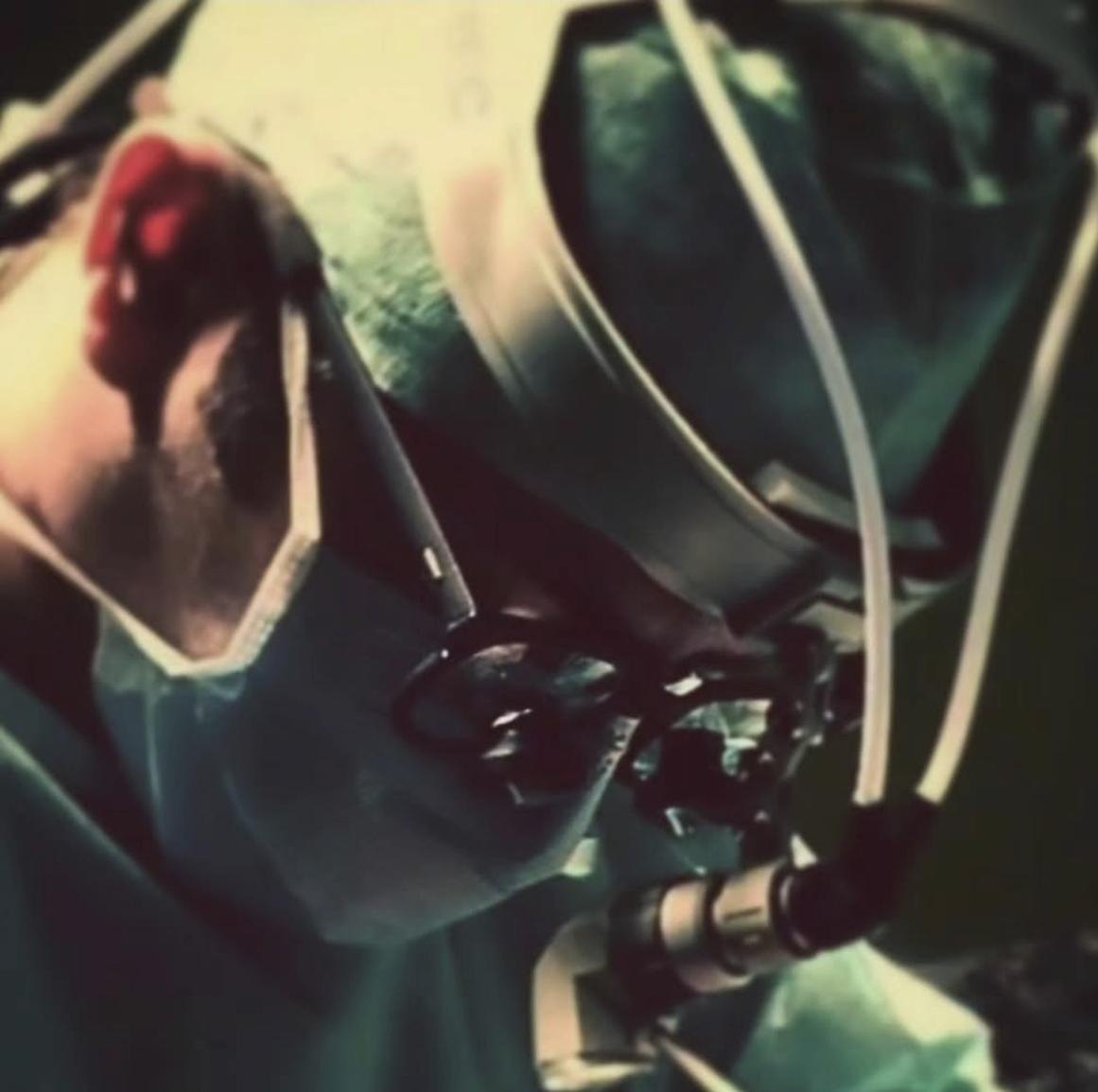
Stefano Cafarotti
Thoracic surgeon, head of department and professor at the Università della Svizzera italiana, he is clinical director of the Lung Centre of Italian-speaking Switzerland at the Ente Ospedaliero Cantonale. He is president of ALCASE Ticino and of the board of the heads of the oncology centres of Italian-speaking Switzerland; since 2025 he has been a member of the direction board of Lega cancro Ticino. He was vice president of Fondazione Sasso Corbaro.
In 2022, at the Cardiocentro in Lugano, he performed what has been described as the world’s first transplant of the pulmonary artery trunk for the treatment of a tumour, within the radical resection of a thymic carcinoma, reconstructing the artery with a homograft on an arrested heart.
But it is precisely in the practice of a surgery able to intervene upon the deepest matter of the body that a further question arises: is it enough to repair the biological machine in order to care for a human being?
For MR.MATTI the answer does not belong to art alone. It has also become an object of research. He has published a scientific study on the role of art in processes of care, and is working on a clinical trial on the use of classical music in patients undergoing pulmonary resection, studying its effects on cortisol and on the consumption of analgesic drugs.
His artistic research begins in the same territory. Il tremore della cura, written within the Medical Humanities of Fondazione Sasso Corbaro, poses a question that will then pass through the works: do we care for a body, or do we care for someone?
Medicine can cut, remove, replace, reconstruct. It can even change an artery. But a human being does not coincide with their anatomy. There is a body that can be repaired, and there is someone who inhabits that body.
It is in the space between these two dimensions that MR.MATTI works.
For this reason he does not illustrate the operating room, and does not turn medicine into iconography. He brings into art the responsibility that precedes every gesture of care: when to cut, what it means to repair, where the technical act ends and where the other begins.
The scalpel is not a symbol: it truly cuts. The moment it crosses the canvas, the surface ceases to be only the place of the image and becomes vulnerable matter. The suture, in the same way, does not represent care: it really attempts to join again what has been separated.
But it does not erase the cut.
To care does not mean to return something to what it was before. It means to let it exist after what has happened to it.
The scar then becomes a material memory of time. The canvas takes on something of the body not because it represents the body, but because it shares its condition: it can be opened, wounded, recomposed. And what is recomposed never returns identical.
It is here that the work stops speaking of the wound and begins to share its condition.
The wound is not the subject of the work. It is a condition of existence. Care is not its cancellation. It is the human way of answering it.
And the cut no longer leads toward a space beyond matter.
It does not open onto the infinite. It opens onto man.